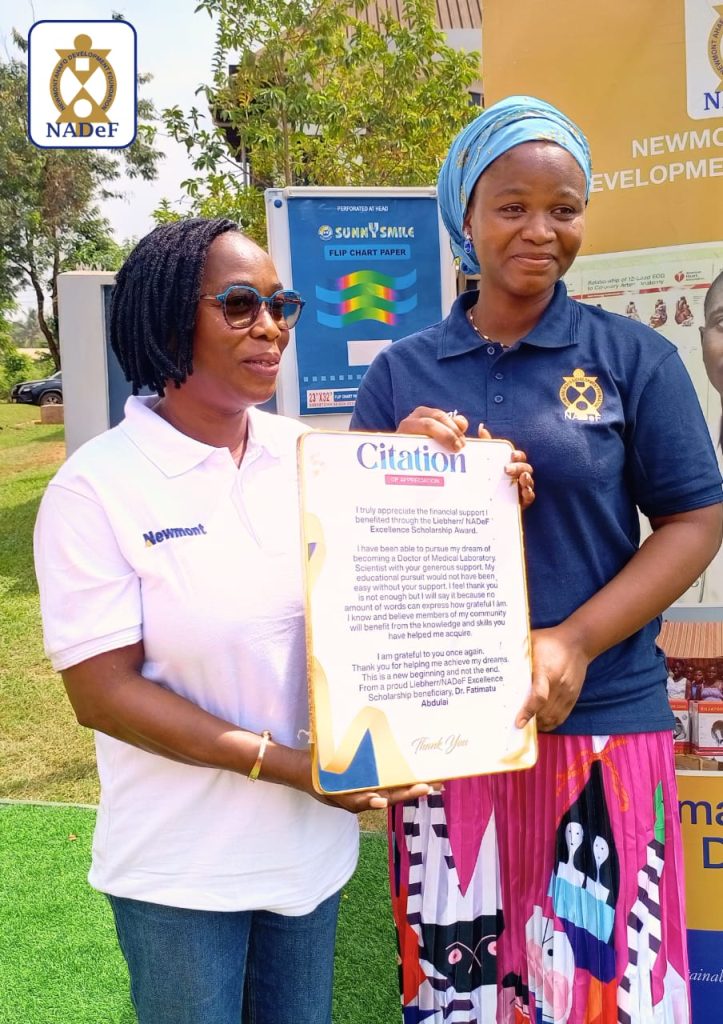
Hundreds of beneficiaries of the Newmont Ahafo Development Foundation (NADeF) earlier today thronged the premises of the Foundation in Ntotroso to participate in their maiden Homecoming Programme, marking a major milestone in NADeF’s 17-year journey of community-centered development in Newmont’s ten host communities in Ahafo.
The occasion was under the theme: “Connecting the past, inspiring the future.”
The Ahafo Regional Minister, Mrs. Charity Gardiner and the Asutifi North District Chief Executive, Hafiz Dauda, who are both proud beneficiaries of NADeF scholarship, were among the dignitaries who graced the occasion.
In his address, Chairman of the NADeF Board of Trustees, Prof. Yaw Ofosu-Kusi, described the event as a historic moment that celebrates resilience, shared dreams and the tangible impact of sustained investment in human capital.

“This gathering is not just a ceremony; it is a celebration of progress and a living proof that the vision behind NADeF was not only noble but achievable,” Prof. Ofosu-Kusi said.
Prof. Ofosu-Kusi noted that through strong collaboration with traditional authorities, district assemblies, educational institutions and development partners, NADeF has grown into one of Ghana’s most respected corporate–community development models.
He acknowledged Newmont Ghana Gold Limited for its consistent financial commitment to the Foundation, contributing US$1 per ounce of gold produced and one per cent of its annual net pre-tax profit from the Ahafo Mine.
Highlighting human resource development as a core pillar of NADeF’s work, Prof. Ofosu-Kusi revealed that the Foundation has invested GH¢42.8 million in scholarships since its inception, benefiting 14,307 young people across the host communities.
Out of this number, 7,855 beneficiaries (54.9 per cent) are males, while 6,452 (45.1 per cent) are females, reflecting what he described as a strong commitment to gender inclusion. The beneficiaries include 7,862 tertiary students, 5,042 secondary school students and 1,403 apprentices supported through vocational and technical skills training.
“These figures are not just statistics,” he stressed. “They represent transformed families, empowered individuals and communities reimagining their potential.”
According to the Board Chairman, many NADeF beneficiaries are now serving in key sectors locally and internationally as doctors, nurses, engineers, ICT professionals, teachers and entrepreneurs, contributing significantly to national development.
Speaking on the topic: “Networking – Giving Back to Community: The Power of Networking” Dr. Mrs. Vida Owusu Prempeh, a Senior Lecturer at the Department of Marketing, Sunyani Technical University, called on beneficiaries of the NADeF Scholarship Scheme to deliberately use networking as a tool for giving back to their communities and driving sustainable development.

Dr. Owusu Prempeh noted that networking is often misunderstood as merely exchanging business cards or seeking personal gain.
According to her, true networking, particularly within a community context, is about building genuine relationships, fostering collaboration, and creating a strong support system that benefits all members.
“You understand the challenges and opportunities within your communities better than anyone else, and this common ground is a fertile starting point for impactful initiatives,” she said.
She highlighted the diversity of academic disciplines among the beneficiaries, describing it as a “goldmine for innovation and problem-solving.” Engineers, doctors, teachers, agricultural experts, and entrepreneurs within the same network, she explained, can pool their skills to address complex community challenges.
She further encouraged the scholars to see themselves as future mentors who can guide younger beneficiaries, thereby creating a cycle of support and development.

The Executive Secretary of NADeF, Elizabeth Opoku-Darko, explained that the programme was meant to provide a platform for the beneficiaries to reconnect, share experiences, and reflect on their role in advancing development within Newmont’s host communities.
She noted that beyond awarding scholarships to the youth in Newmont’s host communities, NADeF is also interested in how best they could give back to their communities upon completion of their programmes.
Newmont’s Director of Social Performance, Joseph Danso, who is also a former Executive Secretary of NADeF, said it was imperative for measures to be put in place to manage graduate unemployment in the company’s host communities, especially among the scholarship beneficiaries.

This, according to him, explained why Newmont has, since 2020, been injecting $300,000 into NADeF towards job creation investments in Ahafo.
Some of the beneficiaries testified at the programme about how the scholarship has immensely impacted their academic journey so far.